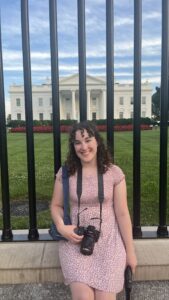



Missouri-based journalist Maggie LeBeau on the importance of community-focused reporting
March 23, 2025
By: Anthony Payne
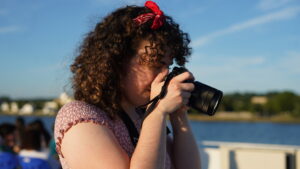 Maggie LeBeau’s love of journalism is rooted in community. Starting high school during COVID lockdowns, she found that joining the school newspaper helped her connect and make up for what was lost online. Once in-person classes began, she found her school beset with protesters upset about the mask-mandates. She interviewed parents and students to see what they felt about it, and cites this first push out of her comfort zone as the catalyst for her interest in local journalism.
“I interviewed people from both sides, and I just remember feeling this high afterwards, like ‘whoa, I just did that,’ she remembers. “I just talked to those people even though it was kind of scary.’ Ever since then, I feel like I’ve been a lot more comfortable just going up to strangers.”
Maggie has been following that feeling since. Now a journalism student at University of Missouri-Columbia, she has worked with the Student Press Law Center and Poynter’s MediaWise, and as news editorfor her campus paper and journalism ambassador for her university. After starting as a volunteer, she’s now a morning news anchor at KBIA 91.3 FM, where she recently interviewed a small-town hemp farmer who was nearly forced to shut down by a new bill.
“That town is super small, so 30 to 40 people losing a part-time gig can be really detrimental to the community,” she says. “Telling stories like that, and not just more ‘oh, President Trump passed this thing,’ and getting into how it’s impacting where you live right now is more important. Local news can capture nuances that national news can’t.”
She continues, speaking on the importance of local journalists who are ingrained in the community: “A lot of the time, if something happens in a town and it gains national recognition, reporters will come in, they’ll report on it and then they’ll leave. But local reporters and people in the community have known about those issues for a long time. They’ve seen how it’s changed over time, and capturing that change is really important in getting the story right. Getting accurate information that is geared towards your specific community is really great, and working with PBS News SRL showed me why that’s important.”
Maggie’s SRL experience began with a lesson in persistence. She did not get into the Academy her first try, but applied again and attended her senior year of high school.
 “It was honestly a life-changing week,” she recalls. “That might sound kind of cheesy, but it really opened my eyes to so many things. Everyone there was super helpful and nice and I made some friends that I still am in touch with today.” She adds: “If anyone out there has gotten rejected either from a journalism program or just in general, you know, sometimes you just got to try again.”
Maggie has continued working with SRL in college, producing a story for the upcoming new season of On Our Minds. Her story follows Missouri’s thriving drag community, as they build a vibrant LGBTQ+ sanctuary in Columbia and expand into other traditionally conservative rural areas. She says this story was inspired by her work on On Our Minds: Election 2024, for which she produced a story about conservative rural voters in blue Illinois.
“I like stories that challenge stereotypes of how homogenous politics are, showing the nuance of geography. Just because you live in a state that might be conservative or liberal doesn’t mean that you necessarily align with that ideology.”
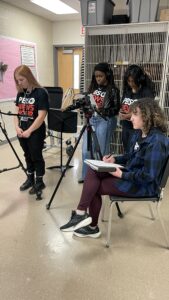 In the future, she’d love to work in public media full-time, but for now she’s enjoying her time at Mizzou. She’s making full use of the resources their journalism program offers, with plans to study abroad in Brussels this fall.
“I love Mizzou. I love how big it is, I love the people and the community here. I feel like the nice thing about going to a state school is that you get to meet people from all different backgrounds. I think that’s really important as a journalist, making sure you aren’t spending all your time with just Ivy Leaguers.”
She acknowledges that media is a scary industry to enter, stability-wise, but her belief in the work overshadows the uncertainty. Her advice to aspiring reporters in high school is to reach out to people who are doing what you want to do, and don’t be afraid to hear “No.” Keep up with what’s going on in your communities, and support your nonprofit newsrooms.
“I think the reason why people have issues with the media right now is because they don’t always capture the nuance of things,” she says. “They make it out to be very black and white. I think that’s part of why we’re so polarized as a society. Local and nonprofit news does a better job of explaining what people are actually experiencing, and makes it community and people-focused. You talk to real people who are experiencing real things.”
She acknowledges that the change of graduating can be daunting, choosing a next-step and leaving home can be nervewracking, but going through that has taught her that she can rebuild anywhere. “No matter where I go postgrad, I know that I can make a new life because I already have. I didn’t know anyone, but now I’m thriving and I have a wonderful community. That gives me the reassurance that even though the journalism industry is crazy right now, no matter where I go, I know I’ll be able to land on my feet.”