

SRL Alumni Q&A with Howard University freshman Julia Mayi
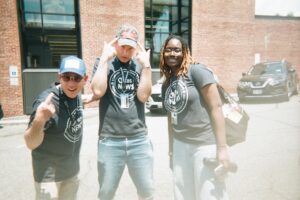 By: Anthony Payne, Mishly Castro-Rivas, and Marianna Ramcharan
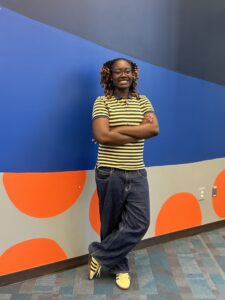
Julia Mayi participated in SRL’s 2025 Summer Academy, where she produced a story about a Go-Go music museum in Washington D.C. In high school, she was made lead producer on her school’s broadcast new show. This year, she started her first year at her dream school, Howard University, where she’s majoring in Communications Studies with a minor in economics. In this alumni Q&A, Julia shares her advice for getting into college, how she grew as a journalist and her thoughts on the future of the industry as someone looking to enter it professionally.
This Q&A has been lightly edited for clarity.
 How did you arrive at Howard University?
So Howard has been my dream since forever. When I was a little kid I would say I was going to Howard. When I got to eighth grade, I kind of locked in on that, but I didn’t know what I was going to go for. At the end of my senior year when I decided that I would like to pursue journalism, I looked at all the HBCUs that would cater to my dream and Howard came out number one every time. I worked at it. I prayed about it every single night. I wore a Howard t-shirt every night. And I told people I was going to Howard even though I didn’t know I was going to Howard. And then in March I got my acceptance letter.
Do you have any advice for any high school students trying to get to their dream schools?
I would recommend if you are ever deferred, write that letter of interest. I was actually deferred and I wrote a letter of interest and that’s what put my application over the edge. I also recommend beefing up your extracurriculars. I’m not saying join every single club, but gain leadership skills. Do something that can set you apart. I didn’t come into Howard even with what people would think are the best grades. I have A’s and B’s. I have C’s. but I was able to make it here. And it’s just by believing in yourself, too.
What’s something in journalism that you initially found actually to be really challenging?
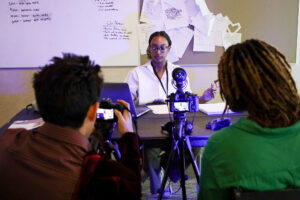 In my experience it’s been going to actually interview people, because even though I am a social person, meeting people in the right moods and trying to get them to be open about a topic and when you don’t know them is hard.
Also I learned my first story ever that actually putting together a story all by yourself is hard. I worked by myself for a majority of my whole high school career. I did not want to work with people because I felt like people don’t pull their weight. So I put all of that emphasis on myself. And making a story from scratch and having to lay the foundation for it is hard when you don’t have anybody else to bounce ideas off of. It really is.
How does learning journalism skills impact other areas of your life?
I think that journalism is kind of a universal language, because in every industry you have to go asking questions and looking for those answers to get to any career goal. People skills, asking questions, building a narrative. I believe that’s in every single career and those are super important skills, more than ever.
 What’s one thing that you wish you knew before getting into the journalism field?
How to deal with individuals that you’re working with, as a leader. I never knew that I would be put into a leadership position early into my high school career. And being put in that position sometimes made me very uncomfortable with having to deal with peers. They are my equal, but trying to be an authority to them was hard. I wished starting out that I had more skills in grasping everybody’s work ethic and skill level, and the skills to communicate that I’m not here to hurt you. I’m here to help you.
How has journalism changed your way of thinking about critical issues?
Journalism has taught me to look at every side of every story. Everybody has a point, and even though I want to capture a certain side of one I can’t let that get in the way of true facts. I’m trying to give people things that they can consume and learn from – not what I want them to kind of think.
I had to learn how to give people the space to make their opinion. And it’s hard trying not to be biased sometimes, but, you just have to go in with that mindset of just sharing information.
 As a young journalist, what do you see in the future of the industry?
This is a topic that I go back and forth with. Honestly I think that good journalism has the potential to survive. It’s going through a phase of some evolution, in recent years print has kind of gone away, people aren’t even turning on their TVs as much. They get all their information from Tik Tok and whatnot.
It’s really just about how people decide to move journalism. Moving it to a platform where people can access unbiased information easily. We will always need somebody on the scene, giving you the news unfiltered. It just feels like we’re in a real censored time, and I don’t feel like filtering my words for anybody.