



SRL 16: “Your Google is not my Google.” Renee Hobbs on teaching media literacy amid an increasingly personalized internet
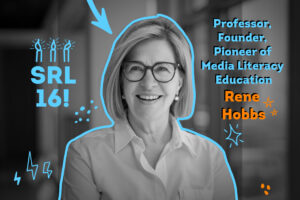 Celebrating 16 years of Student Reporting Labs!
PBS News Student Reporting Labs was founded by Leah Clapman in 2009. What started with six pilot schools reporting video stories in their communities has grown to service hundreds of schools and thousands of educators and students across the country. To commemorate our “Sweet Sixteen,” we spoke with five of the original pilot educators and journalists who helped prove the concept and build the foundation of this vibrant community of storytellers.
Renee Hobbs is a leading academic authority on digital and media literacy education, with 12 books and more than 150 scholarly and professional articles. Currently, she is the Founding Co-Editor of the Journal for Media Literacy Education and a professor at the University of Rhode Island. In 2003, Renee founded the Media Education Lab, a public benefit corporation that advances the practice of media literacy, education through research, scholarship and community engagement.
After meeting Leah at a conference, Renee was enamored with the idea of Student Reporting Labs. In 2013, she assembled a team of graduate students at Temple University to develop a research study on SRL, which found that participation in the program increased students’ intellectual curiosity, openness to constructive criticism, and desire to help solve issues in their community, among other attributes.
In this Q&A, Renee gets into what’s changed for media literacy educators in the age of the algorithm, and addresses how we can have conversations across communities as the internet becomes more personalized.
This Q&A has been lightly edited for clarity.
What is your mission at the Media Education Lab?
Here’s the thing, if you’re a math teacher, the way you teach math is the same as it was this year, as it was last year, as it was the year before that, right? Because, like math, you know, ratios and geometry kind of are kind of timeless and eternal. But if you’re a media teacher, you cannot be teaching about advertising the same way you taught about advertising five years ago, because advertising is completely different now, right? Now, you’re teaching about influencers, sponsored content, forms of advertising that have emerged in the social media age. We help teachers be on top of what they need to know.
We’re pretty famous for our Courageous Conversations program, a collection of free classroom resources on PBS Learning Media. It includes topics like why media literacy matters in preventing violent extremism, we do critical analysis of news stories about mass shootings, conflict entrepreneurs – those are the people who monetize conflict for pleasure, power and profit. We talk about why we trust influencers more than we trust experts, free speech, hate speech and censorship, cancel culture and content moderation, and the pathways to radicalization.
How has young peoples’ relationship to media changed?
I would say the most important thing that’s changed is the rise of algorithmic personalization. Your Google is not my Google, your Netflix is not my Netflix. The content that you are being shown is something that you helped to create with every like, click, and share. And this phenomenon has got benefits and it’s got risks. It’s got benefits because, man, it’s like, Google knows my mind. They know what I’m thinking. I wake up in the morning and they know what I like – and that feels really good. That means I use the media more because it actually is being super helpful to me.
It also means that I don’t recognize persuasion as easily. It doesn’t even seem like persuasion. That influencer who’s got that new mascara, or the lady with the treatments for thinning hair, I don’t even see that as persuasion. That’s informative to me, right? But no, it’s actually really intentionally designed persuasion, made to bypass my head and go straight to my heart – and my pocketbook.
Algorithmic personalization is the topic that I feel has most fascinated me over the last five years, and that we’re still trying to find ways to teach with that. Think of the teacher’s challenge. The room is full of 30 kids, but only like five of those girls are seeing the makeup influencer, right? And another five girls are seeing the environmental justice crusader. And 10 of the boys are seeing the Twitch streamer who’s saying “whoa, cool, white power.” The teacher has no idea that these kids are living in these personalized, different media worlds. How do you have conversations? How do you have dialog and discussion in the classroom? Some kids knew about Charlie Kirk when that happened, but some kids were not familiar with that particular influencer.
Those are the challenges that teachers have to face now, in an era where personalization has changed our relationship with the media and created new challenges for talking across communities.
Where do you begin to teach this stuff when everyone’s seeing something different?
My main strategy is to have my students share media content with me, and we evaluate it collaboratively. Students are basically invited to choose an artifact that demonstrates an understanding of a concept. I don’t choose the examples, the students choose them. For one lesson, the activity was to find an example of personalized persuasion that you’ve encountered on your social media, make a screenshot, post a link, and then explain why you think it is personalized persuasion. Why was it targeted at you? Then explain how this is beneficial or harmful. They’re seeing stuff I would never see, and they’re having pretty nice conversations about it.
How have these changes influenced the function of propaganda?
I feel very proud to have had an impact on how contemporary propaganda is taught in American public schools because of my book Mind Over Media: Propaganda Education for a Digital Age. The first thing that has to be done is we have to address the word propaganda. When students encounter it, they think “Nazis, World War II; propaganda is something from the past.” So that’s a problem.
We have to recognize that propaganda is something that happens all around us, that propaganda is mass communication that’s designed to influence attitudes, beliefs and behaviors, and that propaganda can be beneficial or harmful. Activists use propaganda to influence public opinion to change the world. So propaganda has got many beneficial effects, and it has some harmful effects. We have to recognize the techniques that make a message, recognize that it’s intentional, strategic, and trying to shape, influence, and reinforce some kind of public opinion. To address the harms, we really have to think a little bit about positionality.
I created a website called Mind Over Media. Basically, it’s an online gallery of propaganda. Anyone from anywhere in the world can upload an example of something that they think is propaganda, explain what technique is being used, and why they think it’s propaganda. Because propaganda is in the eye of the beholder, this tool is designed to promote dialog and discussion so that we make our reasoning transparent. We’re always assessing benefits and harms in light of our own lived experience. We can’t help but evaluate propaganda based on what we know, what we feel, what we think, what we believe. But when we do it socially, when we do it with a group or in a community like a classroom, we can get real insights. We can become more aware of the biases in our own interpretations.
How do we clean up our feeds? Is the only way to just opt out completely and just get a flip phone?
This is a really interesting question. We know that algorithmic personalization happens within minutes of you interacting with the platform. Tiktok is the fastest – within minutes, whatever you like or click is tracked and you’re going to get more of that. I always like to tell my students: garbage in, garbage out. If you find yourself looking at garbage just because you’ve got nothing better to do and it’s kind of entertaining, then you’re going to get a lot more low quality junk, including AI slop. So intentional, strategic scrolling and slowing down before liking, clicking, and sharing goes a long, long way.
Now that I’m aware that every like, click, and share is shaping what I’m going to get in the future, I’m just trying to protect my future self. I can be strategic and intentional, and I can think about the fact that I’m programming the platform.
That doesn’t completely solve the problem, but it does help to change your feed, and most students say they can see that change happen within a week. The other thing, of course, you can do is you can go into your platforms, and turn off personalization. All of them have that capacity.
Where do you get your news?
I am a New York Times junkie. I will carry a copy of the paper New York Times to my grave. I also have influencers that I really trust and respect. And some are your usual suspects, right, but some are not. Since I’m an old lady teaching undergraduate students about internet culture, I cannot keep up with internet culture. There’s just no way, right? And yet, I can rely on influencers I respect to keep me in tune with internet culture. One that I really love is Tiffany Ferguson. I feel really grateful that there are influencers like her who are using the power of long-form YouTube to cultivate an online community where people can critically analyze the kinds of media they’re encountering in their online lives.
What role does public media play in teaching media literacy?
I’m so old that I have lived through a whole lot of eras with this topic. The media literacy movement benefits from having educators in different positions and in different walks of life. Public media plays a huge role.
Children’s media producers on shows like Arthur and Ruff Ruffman started incorporating media literacy themes in the late 90s and early 2000s. It was thrilling to see that happen. But once a kid is seven, there is no children’s media. PBS has never been good at keeping children in the public media universe after the age of seven. So unfortunately, a lot of media literacy happens during adolescence and young adulthood – PBS really couldn’t move any traction on that.
That’s why finding Leah Clapman teaching it to teenagers was so revolutionary. She literally was the only person in the public broadcasting world who had her eyes laser focused on high school students, and who recognized their need for media literacy. And so she’s a real pioneer in many, many senses.
Now today, public broadcasting is weaker than it’s ever been in my lifetime, and faces enormous challenges. And yet at the same time, a big challenge is an opportunity to reinvent, right? With the rise of generative AI, there is a new demand for a new kind of media literacy that addresses what students need to know and be able to do with large language models, making generative AI work for them as learners with a lot of intellectual curiosity. There’s a lot of unaddressed issues for media literacy and teenagers.For instance, we don’t have very good media literacy around issues related to sports journalism or sports gambling. Kids are gambling via sports media even before they get into high school. There needs to be media literacy around how athletes as young as high school address their online identities, and especially in relation to their fans, critics, and potential employers. There are tons of opportunities for public media to reinvent itself in the media literacy arena.