



Teacher Feature December 2025: Monique Harris Schramme
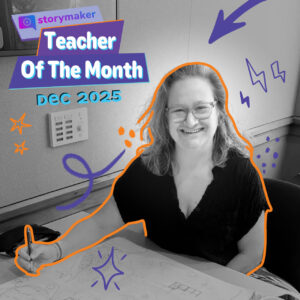
Monique Harris Schramme is a visual art and media educator at Lexington High School in Massachusetts, where she leads the Highline journalism and broadcast course, the Design Hive Collaborative, the Re:Frame Student Film Festival, and a suite of classes in digital video, animation, and graphic design. Her work centers on student voice, storytelling, media literacy, and justice-driven design. She creates spaces where young people learn to see differently, tell their own stories with purpose and power, and shift the narratives that shape their world.
Discover Monique’s favorite lessons, pro tips, and reflections on embracing neurodiversity to make teaching and learning more accessible in the Q&A below
How long have you been using StoryMaker resources? I started integrating StoryMaker and SRL resources into my classes this summer, after attending the SRL Teacher Workshop and seeing how powerfully they support student storytelling and journalism.
What’s your favorite StoryMaker lesson or prompt? My favorite StoryMaker lesson is Experiment with Storytelling Formats. It’s truly a powerhouse. I teach three levels of video production, and this one lesson works for everyone from 9th-grade beginners to advanced seniors. In Moving Image Studio, students dive right in with just their phones and mic sets. In Digital Video Production, it becomes a mid-semester storytelling challenge using DSLRs and real community interviews. And in Highline, it’s the perfect refresher or on-ramp for students who haven’t taken prior courses.
It was also my gateway into StoryMaker, offering rich, flexible, and energizing content that made jumping in feel exciting instead of overwhelming. It’s the kind of lesson that grows with your students and keeps the creativity flowing.
What’s a media-making tool or resource you can’t live without? Adobe Premiere Pro is the tool I can’t live without. The new transcription option has become essential for my students; it helps them break down interviews, find the heart of their stories, and edit with clarity and intention
What’s your advice for teachers and educators just getting started on StoryMaker? Honestly, just go for it! The SRL community is incredibly supportive, the resources are gold, and the magic happens when you step back and let students take the lead.
Links to student work: Re:Frame Student Film Festival, Re:Frame Film Festival on IG, Instagram, Animation Showcase
What’s something exciting happening in your classroom right now? I shared this recently on the SRL Community Commons, but this year, our Highline journalism and broadcast class is off to an incredible start! After just a month, we launched Episode 1 of our Highline Highlights, a student-run broadcast that’s growing stronger every week. It’s only our second year running Highline as a class, and I’m so proud of how my students are stepping up, collaborating, and learning from one another. You can check out their first episode here.
During your recent TRL chat (link), you talk about using AI transparently in your teaching practice and how certain aspects of written communication can be disabling for you. Could you share more about your personal journey with neurodiversity, how it has shaped your approach to planning and teaching, and the ways AI supports you in making your work (and your teaching) more accessible and visible?
My neurodiversity has shaped my entire life. I’m dyslexic, ADHD, bilingual, and a first-generation immigrant whose first language is Spanish. I grew up in schools with no learning supports, so for years I assumed something was wrong with me. As an adult, understanding the social model of disability changed everything. I am not disabled by my brain; I am disabled by environments that weren’t built for the way my brain learns, processes language, and communicates.
That perspective deeply shapes my teaching. I design for the way humans actually learn — visually, collaboratively, through modeling, through storytelling, through clarity and purpose.
Clear communication is essential for student learning. Students deserve to know what they’re doing, why it matters, how to do it, and how they’ll be assessed. But translating my internal clarity into written expectations, rubrics, and assignments has always been challenging because of the cognitive load. AI has made that part of teaching accessible to me. It doesn’t replace my thinking; it allows my thinking to be seen. It helps me articulate learning goals, make rubrics explicit, and give students the transparency they deserve. Instead of getting stuck in language, I can focus on designing meaningful learning experiences and ensuring students understand exactly how to grow.
I’ve seen a real decrease in students feeling confused about what to do next or how they will be assessed, because AI helps me create checklists, rephrase assignments, and refine rubric language in ways that are immediately understandable. AI has allowed my executive functioning challenges to stop being a barrier and instead become part of a workflow where I can co-create curriculum, structure, and community alongside my students.
Using AI openly is part of my commitment to equity. Many of my students are multilingual, neurodivergent, or navigating systems not designed for them. By modeling how tools can remove barriers, honor our strengths, and expand what is possible, I hope they feel empowered to do the same. It helps me show up fully as an educator, without masking, and create a classroom where both my students and I can thrive. AI hasn’t changed my teaching philosophy; it’s made it possible for my students to actually see it.
What’s a dream story you’d like to report on or a person you’d like to interview? A dream interview for me would be with someone like Ava DuVernay, whose work beautifully blends storytelling, justice, and community voice. She models the exact kind of narrative power I hope to help my students cultivate. And a dream story would be to spotlight how young people are reshaping narratives around identity, justice, and belonging in their communities. I’m constantly inspired by the way students see the world, and I’d love to highlight the change they’re already leading, especially the behind-the-scenes moments where you can see them shaping their stories in real time.
Currently listening to: Naïka (especially Layers), 99% Invisible, Alex Warren, Teddy Swims, Mercedes Sosa, On Our Minds, The Cult of Pedagogy, Green Day, Calle 13
Fun fact: Monique recently joined Youth Media Producer Justin Rhodes for a TRL Chat on navigating multiple classes through diverse learning styles. Catch the full conversation in the SRL Community Commons.
You can reach out to Monique directly to learn more about how she’s integrated StoryMaker into her classroom. Email her at mharrisschramme@lexingtonma.org