



TEACHER FEATURE May 2026: Irwin Rogers
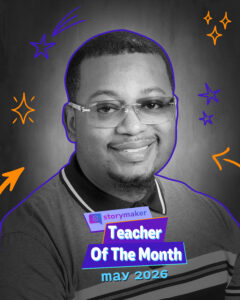
Irwin Rogers is an educator and media-making advocate at Legacy College Prep (KIPP DC) in Washington, D.C., where he teaches students to use journalism, storytelling, and digital media as tools for voice, confidence, and community connection. His approach is shaped by his own experience in a high school broadcast journalism class, where he first witnessed the transformative power of student storytelling.
Discover Irwin’s favorite tools, pro tips, and the morning practice that sets the tone for his classroom in the Q&A below. Spoiler: it involves Bill Withers.
How long have you been using StoryMaker resources? 3 years
What are your favorite StoryMaker lessons? Find Your Story. I appreciate this lesson because it teaches students that journalism begins with curiosity, listening, and noticing what is happening around them. The lesson asks students to think about what makes something newsworthy, including timeliness, proximity, conflict, human interest, relevance, and solutions. It also helps students move from a broad topic to a focused, visual story idea.
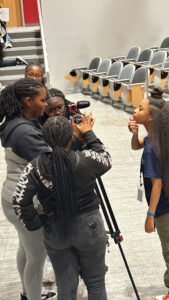 I especially like how the lesson pushes students to see their own communities as worthy of serious reporting. In my classroom, that matters because students often have powerful stories around them, but they may not initially recognize those stories as journalism. Find Your Story gives them a structure for turning lived experiences, school issues, family conversations, and local concerns into meaningful media projects. More importantly, they learn that their voices belong in public conversations. It builds student voice, civic awareness, and confidence at the same time.
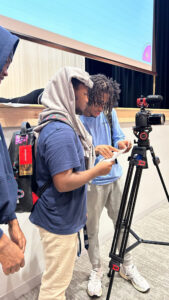
What’s a media-making tool or resource you can’t live without? My favorite piece of media-making equipment is my Lumix GH5. I love how versatile it is for video production, especially when capturing student stories, interviews, school events, and documentary-style footage. It gives me the flexibility to create professional-looking content while still being accessible enough to use in a fast-paced school environment.
What’s your advice for teachers and educators just getting started on StoryMaker? Start small and focus on student voice before focusing on production quality. StoryMaker works best when students understand that their ideas, questions, and lived experiences are the foundation of the story. My advice is to begin with a simple prompt, a short interview, or a 30-second story before moving into a larger video project. Give students structure through sentence starters, planning templates, and clear roles, but leave enough room for creativity and ownership. The goal is not for every piece to look perfect at first. The goal is for students to learn how to ask meaningful questions, listen closely, organize information, and tell stories that matter. Once students realize their voices can inform, inspire, and challenge others, the technical skills become easier to teach.
What’s a dream story you’d like to report on or a person you’d like to interview? Ava DuVernay, because of the way she uses film to elevate history, identity, justice, and voice. Her work shows students that storytelling can be both artistic and purposeful. I would love to ask her how young creators can use media to tell powerful stories about their communities while staying grounded in truth, care, and responsibility.
 What are you currently listening to? Currently, I listen to “Lovely Day” by Bill Withers every morning before walking into the building. It helps set the tone for my mood and reminds me to enter the day with joy, calm, and purpose. As an educator, that mindset matters. The energy I bring into the building often shapes how I greet students, how I respond to challenges, and how I create the classroom environment. That song gives me a moment to reset, breathe, and start the day grounded.
Fun or interesting fact? I took broadcast journalism in high school, and that experience shaped the way I think about student voice, storytelling, and media. It helped me understand how powerful it can be for students to research, speak, film, and share stories with a real audience.
Now, as an educator, I want my students to experience that same sense of engagement and purpose. I hope they leave the course with not only stronger communication and media skills, but also a deeper appreciation for journalism as a field that helps people tell the truth, represent their communities, and make their voices heard.
You can reach out to Irwin directly in the SRL Community Commons to learn how he’s adapted StoryMaker for his program.